 |
Cybertelecom
Federal Internet Law & Policy An Educational Project |
Experimental to Operational
|
ARPANET 1970s: Experimental to Operational |
|
|
|
1970
- BBN operates the ARPANet NOC [Quarterman 1997] [Swedin 115]
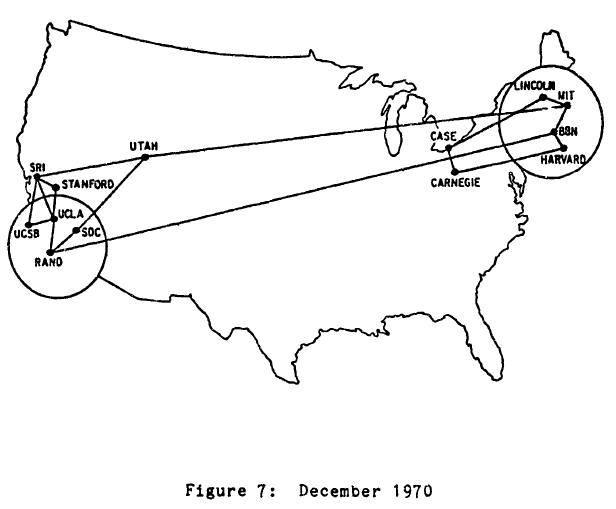
- March: ARPANet connects from West Coast to East Coast at BBN. [Roberts, Net Chronology][Abbate p 64]
- ARPA's contract with BBN to build IMPs is extended. [Nerds p 100]
Lawrence G. Roberts & Barry D. Wessler, Computer Network Development to Achieve Resource Sharing, in Proceedings of AFIPS Spring Joint Computer Conference (AFIPS Press, 1970).
Host to Host
1969-70NCP
1970-82TCP/IP v4
1983 - ??IPv6
1996 - ??Network Working Group
Steve Crocker recounts that while they were given this IMP to operate, they kept expecting at some point someone would show up and tell them what they should be doing; they never did show up. While awaiting for direction, it was decided that they needed some system of tracking and recording their work. To that end, Crocker created the Network Working Group (NWG), the forerunner of the Intertnet Configuration Control Board (1979) and the IETF in 1986. NWG meets in Atlanta [Padlipsky] [Salus p 29] [DARPA 1981 II-11 ( "Beyond these two specific contracts, some rather ad hoe mechanisms were pursued to reach agreement between the various research contractors about the appropriate "host protocols" for intercommunicating over the subnetwork. The "Network Working Group" of interested individuals from the various host sites was rather informally encouraged by DARPA. After a time, this Network Working Group became the forum for, and eventually a semi-official approval authority for, the discussion of and issuance of host protocols to be implemented by the various research contractors. Progress in this area was rather slow for a while, but with time, this mechanism eventually was successful in establishing effective host protocols.")]
Crocker was concerned that the act of writing things down would be an assertion of authority. To emphasize that these were not official decrees, the documents produced by this body came to be known as Requests for Comment. Crocker figured that this would go on for a few months until Washington DC stepped in and told them what to do.
"A month later, after a particularly delightful meeting in Utah, it became clear to us that we had better start writing down our discussions. We had accumulated a few notes on the design of DEL and other matters, and we decided to put them together in a set of notes. I remember having great fear that we would offend whomever the official protocol designers were, and I spent a sleepless night composing humble words for our notes. The basic ground rules were that anyone could say anything and that nothing was official. And to emphasize the point, I labeled the notes "Request for Comments." I never dreamed these notes would distributed through the very medium we were discussing in these notes. Talk about Sorcerer's Apprentice!" [RFC 1000]
Vint Cerf: "we were just rank amateurs, and we were expecting that some authority would finally come along and say, "Here's how we are going to do it." And nobody ever came along, so we were sort of tentatively feeling our way into how we could go about getting the software up and running." [Cerf, Oral History 1990]
In the early 70s, Jon Postel become the editor of the RFCs. RFCs were maintained by Stanford SRI in its capacity as NIC. The RFCs came to be a function of the Network Working Group. [Roberts, Net Chronology][Crocker NYT ("The early R.F.C.'s ranged from grand visions to mundane details, although the latter quickly became the most common. Less important than the content of those first documents was that they were available free of charge and anyone could write one. Instead of authority-based decision-making, we relied on a process we called "rough consensus and running code." Everyone was welcome to propose ideas, and if enough people liked it and used it, the design became a standard.")] [Living Internet RFC History
] [IETF RFC 2555, 30 Years of RFCs
ARPANET History 1981 p. III-45
"The initial design of the ARPANET as contained in the RFQ went some way toward specifying certain formats for inter-IMP communications and for AP-to-host communication. Less explicit attention was given to host-to-host communication, this area being left for host sites to work out among themselves.
"To provide the hosts with a little impetus to work on the host-to-host problems, DARPA assigned the problem to Elmer Shapiro of SRI. After an initial meeting, S. Crocker, S. Carr, and J. Rulifson met again in the summer and fall of 1968 to continue discussion of host-to-host protocol issues. Their early thinking was at a very high level, e.g., the feasibility of creating a portable front-end package which could be written once and moved to all network hosts; a host desiring to send data to another host would first send a data description to the receiving host which instructed the front-end package at the receiving host hcw to interpret data coming from the sending host. On Valentine's Day, 1969, the first meeting of host representatives and representatives from the NMC and NAC, along 4ith the IMP contractor, was held at BEN in the middle of an enormous snow storm.
"In April 1969, a series of working notes called Request for Comments (RFCs) was established, which could be circulated to let others know what they were doing and to obtain the reactions and involvement of other interested parties. They called themselves the Network Working Group (NWG).
"The NWG eventually grew quite large, with representatives from almost every host site in the network participating, and mountains of paper was circulated describing and commenting on various protocols. There were also occasional mass meetings. From about the time it was decided that he would go to DARPA until near the time he left DARPA. Stephen Crocker served as chairman of the NWG. By the beginning of 1972 the NWG had grown too large, but much of its work was done -- large numbers of hosts were communicating over the network. From this point onward, meetings were limited to those of an executive protocol committee which iet to discuss general protocol issues and provide guidance for Crocker, and to those of various subcommittees, e.g., the group interested in the Remote Job Entry protocol. Even after the big meetings stopped, most participant working notes were circulated to most other participants in the network.
"Gradually the activities of the NWG began to diminish. Many of the host site personnel who had originally been active moved on to other tasks, and new users joining the network tended to 0se the defined protocols rather than becoming involved in their specification. As Crocker's time for the NWG group became increasingly limited, he appointed Alex McKenzie and Jon Postel to serve jointly in his place. McKenzie and Postel interpreted their task to be one of codification and coordination primarily, and after a fe4 more spurts of activity the protocol definition process settled for the most part inio the status of a maintenance effort.
Host Protocol
Steve Crocker releases the Network Control Protocol (NCP), the initial host-to-host protocol. [ISOC] [Roberts, Net Chronology] [Abbate p 68]
S. Crocker, RFC001 Host software
Network Working Group Steve Crocker
Request for Comments: 1 UCLA
7 April 1969Title: Host Software
Author: Steve Crocker
Installation: UCLA
Date: 7 April 1969
Network Working Group Request for Comment: 1Introduction
The software for the ARPA Network exists partly in the IMPs and partly in the respective Hosts. BB&N has specified the software of the IMPs and it is the responsibility of the HOST groups to agree on HOST software.
During the summer of 1968, representatives from the initial four sites met several times to discuss the HOST software and initial experiments on the network. There emerged from these meetings a working group of three, Steve Carr from Utah, Jeff Rulifson from SRI, and Steve Crocker of UCLA, who met during the fall and winter. The most recent meeting was in the last week of March in Utah. Also present was Bill Duvall of SRI who has recently started working with Jeff Rulifson.
Somewhat independently, Gerard DeLoche of UCLA has been working on the HOST-IMP interface.
I present here some of the tentative agreements reached and some of the open questions encountered. Very little of what is here is firm and reactions are expected. . . . . .
NWG adopted a layered approach to the specification of communications protocols.
"NCP relied on ARPANET to provide end-to-end reliability. If any packets were lost, the protocol (and presumably any applications it supported) would come to a grinding halt. In this model NCP had no end-end host error control, since the ARPANET was to be the only network in existence and it would be so reliable that no error control would be required on the part of the hosts." [ISOC]
- RFC 33;
- RFC 36;
- RFC 78;
"In many ways a computer network is to host computers as the telephone system is to human users: a transparent communication medium in which even after the caller has learned how to insert dimes and dial, it is still necessary that he speak the same language as the person called in order for useful communication to occur. The common language is referred to as host protocol, and the problem is to design a host protocol which is sufficiently powerful for the kinds of communication that will occur and yet can be implemented in all of the various different host computer systems. The initial approach taken involved the development of a piece of software called a "Network Control Program" which would reside in a host computer, such that processes within a host would communicate with the network through this Network Control Program. The primary function of the NCP is to establish connections, break connections, switch connections, and control flow. A "layered" approach was taken such that more complex procedures (such as File Transfer Procedures) were built on top of simpler procedures in the host Network Control Program." [DARPA 1981 II-18]
Host-to-Host Protocol
"The Network Working Group was established in early 1969. By December 1969 an initial host-to-host protocol had been specified which supported communication between a terminal on one host and a process on another host. At a meeting in Salt Lake City in December 1969, the initial protocol specification was described to Lawrence Roberts of DARPA who was unhappy with it because the initial plan would not support transmission of electronic mail over the network. He instructed the Network Working Group to "go back and get it right."
"By the spring of 1970 several successive versions of a host-to-host protocol had been developed, and a relatively formal meeting of the NWG was held at UCLA before mid-year at which the latest version of the protocol was described. Reactions to the described protocol were very negative. In June of 1970 there was a series of meetings held at UCLA and Harvard at which people from these two institutions tried finally to settle upon a host-to-host protocol and specify how it should be implemented. In August of 1970 some of the more general (and some thought more exotic) aspects of the host-to-host protocol being considered were ordered dropped from the protocol by Barry Wessler of DARPA, thus administratively clearing away some of those issues which had prevented agreement. Tha NWG discussion continued at the 1970 Spring Joint Computer Conference; in particular, there was discussion between Crocker and Roberts regarding the formality to be sought for the protocol, and DARPA approvals required, and so forth. Another NWG meeting was held at the Fall Joint Computer Conference in November 1970 in Houston, Texas."
"At a NWG meeting held in mid-February 1971 at the University of Illinois, a subcommittee was appointed to look at the host-to-host protocol to see what changes were immediately desirable or necessary. This subcommittee went directly from Illinois to Cambridge, Massachusetts, where it met for two days, wrote an interim report, and then reconvened a month later in Los Angeles. It appears that with the efforts of this committee (known as the "host-to-host protocol glitch cleaning committee") the design of the ARPANET host-to-host protocol was finally coming close to being settled."
"At about this same time DARPA was beginning to exert great pressure not only to get the host-to-host protocol settled but also to get it implemented by the hosts. At a NWG meeting at the Spring Joint Computer Conference in Atlantic City in May 1971, Alex McKenzie took on the task of writing a definitive specification of the host-to-host protocol -- not to invent new protocol, but to write down what had been decided.
"In October 1971 the final big NWG meeting was held at M.I.T., and was preceded by a programmers' workshop at which differences in implementations were clarified and eliminated. In January' 1972 a McKenzie document describing the protocol was published and the ARPANET host-to-host protocol has remained essentially unchanged since.
[DARPA 1981 III-61-63]
Xerox PARC established. Robert Taylor moves to Xerox PARC
ALOHANet
July: Norman Abramson builds ALOHANet, using DARPA and NAVY funding. [Nerds 2.0.1] [Roberts, Computer Science Museum 1988] ARPA provides a Terminal Interface Processor to ALOHANet [Nerds p 103] [Roberts, Net Chronology] [Abbate p 115] ALOHAnet became operational in 1971. Lore has it that Abramsom primarily wanted to go surfing.
Design objectives: "The original goal of the Aloha System was to investigate the use of radio communications as an alternative to the telephone system for computer communications and to “determine those situations where radio communications are preferable to conventional wire communications”" [Abramson 2009]
- N. Abramson (1970). "The ALOHA System - Another Alternative for Computer Communications" (PDF). Proc. 1970 Fall Joint Computer Conference. AFIPS Press.
- "Franklin F. Kuo - Computer Networks-The ALOHA System, Report of the Office of Naval Research, 1981"
- R. Binder; N. Abramson; F. Kuo; A. Okinaka; D. Wax (1975). "ALOHA packet broadcasting - A retrospect" (PDF). Proc. 1975 National Computer Conference. AFIPS Press.
- N. Abramson (December 2009). "The ALOHAnet – Surfing for Wireless Data" (PDF). IEEE Communications Magazine. 47 (12): 21–25. doi:10.1109/MCOM.2009.5350363.
- Abramson, Norman (Mar 1985). "Development of the ALOHANET". IEEE Transactions on Information Theory. 31 (2): 119–123. doi:10.1109/TIT.1985.1057021.
- Roberts, Lawrence G. (April 1975). "ALOHA Packet System With and Without Slots and Capture". Computer Communications Review. 5 (2): 28–42. doi:10.1145/1024916.1024920.
- Calvin Hennick, How ALOHAnet Helped Hawaii Make Waves in Networking and IT Innovation, State Tech June 30 2016
- James Pelkey, Entrepreneurial Capitalism and Innovation: A History of Computer Communications 1968-1988: Chapter 4 Arpanet: 1969-1972, 4.10 ALOHANET and Norm Abramson: 1966 - 1972 ( 2007) ("The ALOHANET was never commercialized for to do so required dealing with the Federal Communication Commission (FCC), the government agency that regulated the use of radio frequencies")
Stu Mathison, Phil Walker, and Barry Wessler meet during the summer to discuss building a commercial network based on ARPANET technology (will become Telenet) [History of Telenet p 29]
Steve J. Lukasik becomes director of ARPA. He will leave ARPA in 1975 and he will join the FCC as Chief Technologist in 1979. [Lukasik]
Roberts intended a two phase start to the ARPANET:
- Phase One: started in 1969 as Initial Research and Experimental Use, with the original 14 nodes and about 2000 people." These ARPA - funded researchers were engaged in Computer System Architecture, Information System Design, Information Handling, Computer Augmented Problem Solving, Intelligent Systems, and Computer Networks. "The major use they will make of the network is the sharing of software resources and the educational experience of using a wider variety of systems than previously possible." A major purpose in this phase is the experiment of the network itself, with Stanford operating the NIC, gathering and monitoring network information.
- Phase Two: intended to initiate after November 1970 to open the network up to the external research community use, expanding the network to about 20 notes. This would open the ARPANET to additional ARPA funded researchers in the areas of Behavioral Science, Climate Dynamics and Seismology.
[Roberts Wessler 1970]
1400 Wilson Blvd, Rosslyn, Arlington, Virginia, was the home of ARPANET from 1970 to 1975. This historic marker was installed in 2011 on the sidewalk outside the old ARRPANET building. It reads:
"The ARPANET, a project of the Advanced Research Projects Agency of the Department of Defense, developed the technology that became the foundation for the Internet at this site from 1970 to 1975. Originally intended to support military needs, ARPANET technology was soon applied to civilian uses, allowing information to be rapidly and widely available. The Internet, and services such as e-mail, e-commerce and the World Wide Web, continues to grow as the under-lying technologies evolve. The innovations inspired by the ARPANET have provided great benefits for society."
The binary sign spells out "ARPANET." Pictured are (Left to Right) Robert Young; Christopher Zimmerman, chair of the Arlington County Board; George Lawrence; Steve Lukasik, former ARPA director; Eric Willis; and Francis Niedenfuhr. Picture was taken during an Arlington County Board ceremony.
BBN had an office across the street from ARPA in Rosslyn.
230.4 kbps circuit tested between IMPs. [DARPA 1981 III-53]
[DARPA 1981 III-76]
1971
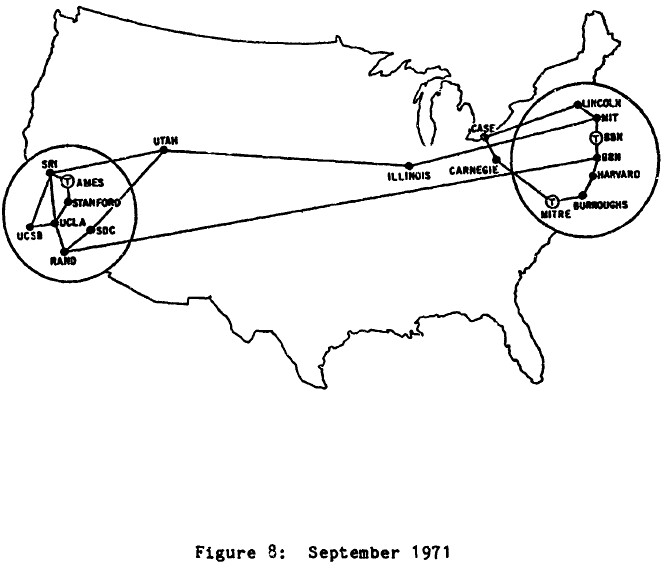
19 nodes on ARPANet including UCLA, SRI, UCSB, Uni Utah, BBN, MIT, RAND, SDC, Harvard, Lincoln Lab, Stanford, U of Ill Urbana, Case Western Reserve, CMU, NASA-Ames [Hauben] NIST joins ARPANET December 1971.
Personnel
- Steve Crocker joins IPTO as a program manager.
- Stephen Lukasik becomes Chief of ARPA. He was a major proponent of network research of of electronic mail. Would become FCC Chief Scientist in 1979.
- Alex McKenzie took charge of the Network Control Center at BBN. He envisioned the ARPANET as a "computing utility." [Abbate p 65]
- Bob Kahn at BBN suggest public demonstration of ARPANET [DARPA 1981 III-96]
Missed Opportunities
- 1846: USG declines Morse's offer to sell telegraph invention for $100,000. Post Office spends next 70 years arguing that USG should purchase telegraph system.
- 1873: Western Union declines Edison's offer to sell quadruplex telegraph for $450,000. Edison sells it to Jay Gould.
- 1876: Western Union declines Bell's offer to sell telephone invention for $100,000
- 1972: AT&T declines ARPA's offer to give them the Internet, with the USG becoming an anchor tenant.
- 2000: Blockbuster decline's Netflix offer to sell Netflix for $50m.
"Buy when the stock is first offered." - Chauncey Depew. AT&T:
Larry Roberts wants to avoid DoD owning and operating the Internet. Therefore Roberts approaches AT&T offering it to them, offering to give them the network and have the USG as an anchor tenant customer. "AT&T could have owned the network as a monopoly service, but in the end declined." "They finally concluded that the packet technology was incompatible with the AT&T network," Roberts said. "AT&T would not build its first packet switched network until 1982. [History of Telenet p. 29]
"Bob Taylor also tried to talk to AT&T about the venture. "When I asked AT&T to participate in the ARPANet, they assured me that packet switching wouldn't work. So that didn't go very far." " [Nerds2.0 p 74] [Vanity Fair (quoting Bob Taylor, "Working with AT&T would be like working with Cro-Magnon man. I asked them if they wanted to be early members so they could learn technology as we went along. They said no. I said, Well, why not? And they said, Because packet switching won’t work. They were adamant.")]
Larry Roberts said, "They wouldn't buy it when we were done. We had decided that it was best if industry ran it, because the government had done its experiment and didn't need to run it anymore. I went to AT&T and I made an official offer to them to buy the network from us and take it over. We'd give it to them basically. Let them take it over and they could continue to expand it commercially and sell the service back to the government. So they would have a huge contract to buy service back. And they had a huge meeting and they went through Bell Labs and they made a serious decision and they said it was incompatible with their network. They couldn't possibly consider it. It was not something they could use. Or sell." [Nerds p 109] [See also Vanity Fair (quoting Baran " The one hurdle packet switching faced was AT&T. They fought it tooth and nail at the beginning. They tried all sorts of things to stop it.")]
"Most computer scientists had faced AT&T's infamously bureaucratic billing and marketing practices, or had encountered its stubbornly selfish and legalistic actions in regulatory hearings, or had confronted engineering plans that presumed only one official design for a service and locked out others. While most participants in the Internet could not articulate precisely how the Internet would be governed, most had an almost visceral dislike for the centralization at Ma Bell... the participants know one thing for certain: they did not want the next communications network to resemble Ma Bell..." [Greenstein 38]
"The Washington division was excited. They said to me there was a lot of revenue they were getting from the leased lines; they thought it was great. They got excited about it, and Bell Labs got involved, and they had a huge committee, and I presume they went over and over it, and they kept on looking at it, and eventually -- they never gave a response, because that was their way of doing business, but I found out that Bell Labs had said: "No, it was not compatible with the plan."" [Roberts, Computer Science Museum p. 14 1988]
A History of the Internet: The First Decade, Report No. 4799, Prepared for DARPA by BBN p. II-8 (1981) ("initial payoff was anticipated in the form of technology transfer from ARPANET project in three ways… By transfer of management of ARPANET to a common carrier, and the resulting availability of ARPANET services to other groups.")
"Roberts discussed the issue with Bernie Strassburg, Chief of the Common Carrier Bureau of the FCC. Strassburg advised that the best approach would be to form a new company and apply for an operating license from the FCC." This would be Telenet. [History of Telenet p. 29] [Roberts, Computer Science Museum p. 18 1988 ("we had been talking to Bernie Strassburg during all that period, and that was one of the reasons I had been encouraging people to do it.")]
Strassburg 11-12: "There's some truth to that concern, that AT&T, largely because they were regulated and largely because the regulators favored long lives and low depreciation... so apportionment came about in a very controlled fashion, rather than it does today. AT&T orchestrated the innovation and the retirements... (Pelkey: Do you think that the culture that was set in place in the '60s as a consequence of these kind of attitudes... created a culture that has not caused AT&T to be an innovator in some of these areas?). Strassburg: I think so."
[Johnson 684 ("As I recall, the company had an eighty- year depreciation schedule on its telephone poles. Of course, this elimination of opportunity costs also eliminated opportunity benefits. What was saved for consumers in increased costs was denied to customers in increased efficiencies.")]
S. L. Mathison, L. G. Roberts and P. M. Walker, "The history of telenet and the commercialization of packet switching in the U.S.," in IEEE Communications Magazine, vol. 50, no. 5, pp. 28-45, May 2012. "Roberts met with executives from both companies and neither company was interested in taking over the operation of the ARPANET or operating a commercial version of the network. His offer to AT&T was for ARPA to turn over the current ARPANET to AT&T and purchase back service from AT&T as part of their public service. AT&T and Bell Labs executives studied this offer for months but finally decided that packet switching service was not compatible with their strategy. AT&T would not begin to offer packet switching network services until roughly a decade later (i.e., 1982). Western Union never developed a commercial public packet network service. After finding that current carriers would not take over the ARPANET and offer public service, Roberts discussed the issue with Bernie Strassburg, Chief of the Common Carrier Bureau of the FCC. Strassburg advised that the best approach would be to form a new company and apply for an operating license from the FCC."
See Western Union's Decision not to buy the Bell telephone patents 1876.
TIPs Introduced: "The initial nodal switching units, called IMPs, were intended to interconnect computers and high bandwidth phone lines. At the outset all terminal access to the network was via terminal connections to the hosts themselves. After a time it became clear that there was a population cf users for which terminal access to the network was very desirable, but who were not conveniently able to access the network via a host computer. Thus, a new nodal switching unit, a Terminal Interface Message Processor, or TIP, was defined to serve the purpose of an IMP plus an additional function of direct terminal access. This shift resulted in the design of a TIP which really was a tiny host embedded in a switching node itself and permitted the direct connection of up to 63 asynchronous character-oriented terminals to the switching node. The TIP became the nodal switching unit of choice, often even where there was a local host computer; this allowed connection of both hosts and terminals at that location directly to the network." [DARPA 1981 II-20] [DARPA 1981 III-54]
A Bhushan, RFC 114, A File Transfer Protocol
T O'Sullivan, NWG RFC 158, TELNET Protocol (May 19, 1971)
Project Guttenberg is initiated with the posting of a copy of the Declaration of Independence to Michael Hart's site at the Uni of Illinois.
Tymshare's Tymnet network operational
[DARPA 1981 III-76]
|
Computer History Museum |
1972
Personnel
- Robert Kahn leaves BBN, joins IPTO. [Kahn][Nerds p 109][Vanity Fair] [Waldrop 83]
- Vint Cerf completes dissertation at UCLA in March, goes to Stanford to teach. [Cerf, Oral History 1990]
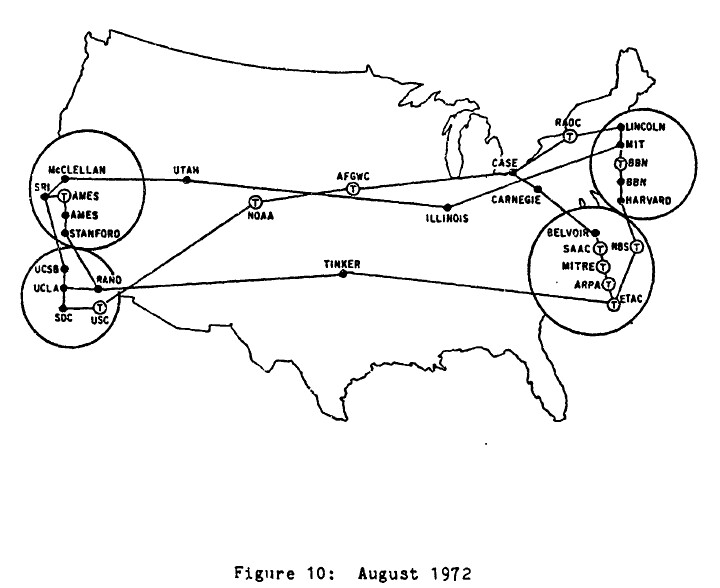
ARPA conducts public demonstration of ARPANet at the IEEE International Computer Communications Conference
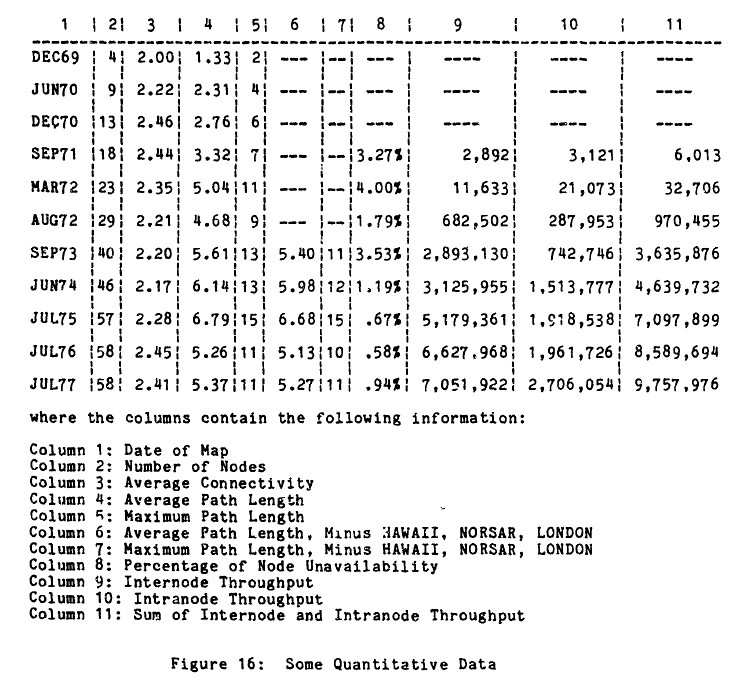
After the success of the conference, network traffic increased 67% and continued strong growth thereafter. [Abbate p 79] With the public demonstration of the ARPANET, the "experiment in packet switching" is established as a success. This marks the transition of the ARPANet from an experimental network to an operational network. [Abbate p 114]
ARPA rechartered as DARPA, removing ARPA from the Office of the Secretary of Defense. [Hauber] [RFC 1000]
Cost of setting up an ARPANET node: $55k - $107k. [Abbate p 84]
Publications
- J. Pickens, RFC 369, Evaluation of ARPANET Services; January through March 1972 (July 25, 1972)
- Steward Brand, Spacewar: Fanatic Life and Symbolic Death Among the Computer Bums,
Last Apollo flight to the moon [Apollo]
October: BBN proposes setting up separate subsidiary to establish a commercial public packet switched network service. Formed Packet Communications, Inc. [History of Telenet p. 32] [Roberts, Computer Science Museum p. 16 1988]
Ray Tomlinson invents network email and adopts the "@" sign.
[DARPA 1981 III-76]
1973
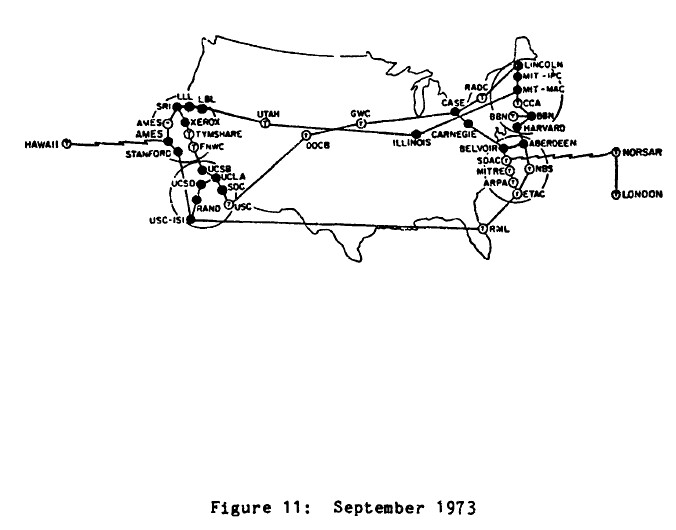
January: 35 nodes to network [Hauben] [History of Telenet p 29 (38 nodes by 1973)]
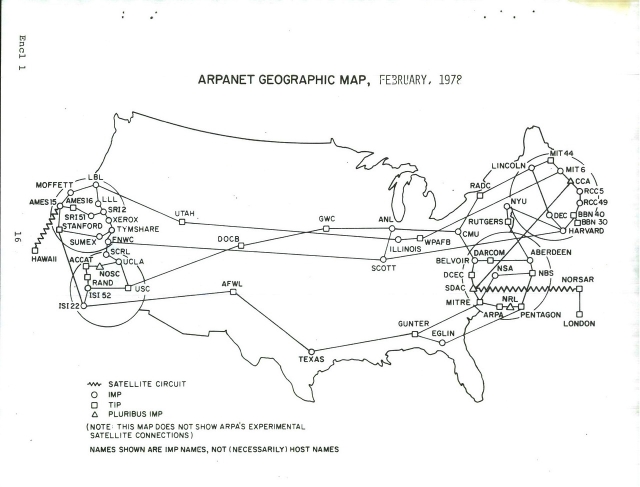
First ARPANET satellite link between California ARPANet and Hawai ALOHANeti. [DARPA 1981 III-55 [Abramson 2009 ("In 1973 the Aloha System used a VHF transponder in an experimental NASA satellite (ATS-1) to demonstrate an international satellite data network (PacNet) connecting NASA in California and five universities in the United States, Japan, and Australia")]
ARPANet connected to sites in Norway and England using Intelsat I satellite. [Hauben] [Abbate p 121] [DARPA 1981 III-56 ("For the first time, circuits had to be obtained from a foreign PTT, the circuits were relatively slow at 9.6 Kb")]
CYCLADES network is demonstrated in France.
March: SRI initiates publication of the ARPANET News [Abbate p 87]
Oct 1: Larry Roberts leaves IPTO to become CEO of Telenet (first public commercial packet-switched network, a subsidiary of BBN). [Roberts, Net Chronology] [Abbate p 80] [Heart p 24 1990] [History of Telenet] [Roberts, Computer Science Museum p. 17 1988]
Robert Kahn becomes head of IPTO. [Kahn]
"Packet Communication by R. M. Metcalfe, MAC TR-114, Dec. 1973"
Federal Communications Commission
- Lee Talbert (formerly BBN), Ralph Alter, Steve Russell for Packet Communications Inc. (PCI) and in January 1973 apply for authorization from the FCC to build a public packet switched communications network. The application was approved in November, however, PCI was not able to raise sufficient funding to build out. [History of Telenet p. 32]
[DARPA 1981 III-76]
| While the ARPANET was restricted to ARPANET funded or affiliated sites at universities and contractors, once a connection was established, access to the connection was relatively open. "'Few system administrators tried to add access restrictions to the network commands. According to BBN's ARPANET Completion Report, "despite a deeply ingrained government and Defense Department worry about unauthorized use of government facilities, it was possible to build the ARPANET without complex administrative control over access or complex login procedures or complex accounting of exactly who was using the net for what.' BBN argued that this relax access policy made the system simpler and thus contributed to its quick and successful completion." [Abbate p 79] |
|
Arthur C. Clarke Predicts the Internet & PC |
1974
Licklider returns as head of IPTO.
Steve Crocker leaves IPTO and returns to UCLA. [Salus p 29]
Ethernet Will Never Work - 1974 Xerox PARC memo...., Broadband Reports 6/13/2007
Larry Roberts, Data by the Packet, IEEE Spectrum Vol. 11, No. 2, pp. 46-51 (Feb. 1974)
Vinton Cerf, Yogen Dala, Carl Sunshine, RFC 675 - Specification of Internet Transmission Control Program (Dec. 1974) (2 8 host addresses / 2 4 net addresses)
"In 1974 Western Union was awarded a contract by DCA to develop a packet switching network called AUTODIN II. AUTODIN I, which has been leased to the government since the 60s, uses a message forwarding scheme." John Roberts, The Defense Data Network
[DARPA 1981 III-76]
1975 DCA Takes Over Operational Oversight of ARPANET
DCA Takes Control of ARPANET; ARPANET evolves from an experimental network to a DOD operational network. [Hauber] [CSTB Realizing the Info Future 237 1994] [ARPANET Brochure 1979, p. 1] [DARPA 1981 I-2] [DARPA 1981 III-105]
"By mid-1975, DARPA had concluded that the ARPANET was stable and should be turned over to a separate agency for operational management. Responsibility was therefore transferred to the Defense Communications Agency (now known as the Defense Information Systems Agency
Richard Barber, The Advanced Research Projects Agency, 1958-1974
"This historical evaluation of the Advanced Research Projects Agency (ARPA) as an R&D management institution was commissioned by ARPA in recognition of the fact that remarkably little in the way of an official recorded institutional memory had been established during its seventeen year lifetime. From Agency Directors to program managers, the turnover in its leadership has been rapid by most bureaucratic standards, thus eroding first hand knowledge of ARPA's role and activities rather quickly. Conceived as a unique management organization chartered to concentrate on advanced research within the Department of Defense, this very uniqueness has frequently been questioned. Virtually every ARPA Director, and most ARPA personnel at all levels, have encountered friendly and not-so-friendly why ARPA? and what is ARPA? questions throughout its history. This report seeks to explain some of the whys and whats. For the most part, the study ends in 1972 when ARPA was designated a Defense Agency. This date was arbitrarily chosen. In instances where events or programs started in earlier periods extend beyond 1972, they have been pursued a bit further for sake of completeness, but not past 1974."
Stephen Lukasik leaves his position as Chief of ARPA. Joins FCC in 1979.
Networks
- PRNET become operational in San Francisco. [Abbate p 118]
- SATNET initiated. First satellite network on the Internet. SATNET was DARPA - Sponsored. [RFC 2555] Connected Stanford US, University College London England and Norway. INTELSAT. Would be a part of a TCP/IP interconnectivity demonstration with ARPANET in 1977. [Living Internet TCP/IP] [Abbate p 121] [DARPA 1981 III-57]
- Telenet begins offering public packet-switched network service in seven cities, as a common carrier service. [Nerds p. 115] [Abbate p 80] [History of Telenet] [DARPA 1981 II-31]
- DECNet released [DECNet, CISCO]
Sept. X-25 approved as standard. [Roberts, Computer Science Museum p. 19 1988]
[DARPA 1981 III-76]
1976
Personnel
- Licklider leaves ARPA again, succeeded by Col David Russell.
- Cerf joins ARPA. [Nerds p 114] [Roberts, Net Chronology] [Waldrop 85]
Queen of England sends email to her subjects celebrating the 25th anniversary of her coronation [Nerds p 113] (when Pres. Bush Jr. when he came to office in 2000 indicated that he would refuse to use email) .
X.25 Standard adopted. [History of Telenet 38]
National Science and Technology Policy, Organization, and Priorities Act of 1976. Established
- NSF Office of Science and Technology Policy
- Federal Coordinating Council for Science, Engineering and Technology (FCCSET). See Federal Coordinating Council for Science Engineering and Technology, Policies and Procedures Manual (Washington, D.C.: Office of Science and Technology Policy, October 30, 1992). [NSF01: Strengthen Coordination of Science Policy] [OSTP p. 8 1987]. It's not clear that the FCC was a part of FCCSET. Its 1987 report did not list an FCC representative.
"Selected Bibliography and Index to Publications About the ARPANET", Becker and Hayes Inc., February 1976, 185 paias, AD-A026900
Networks
- MERIT interconnects with Telenet. [Merit History]
- MFENet provides data links between Fusion Energy and Lawrence Livermore National Labs [ESNet History]
- Experimental Packet Switching Service, operated by the British Post Office, goes online. [History of Telenet 38]
- Tymnet files tarrif with FCC to operate as common carrier [DARPA 1981 II-31]
[DARPA 1981 III-76]
|
1977 First Internet experimental
demonstration
Internet Milestone - 30th Anniversary 3-Network Transmission Computer History Museum (panel starts at min. 21) |
1977
111 Host computers connected to ARPANet. [Hauben]
OSI Subcommittee established. [Salus p 39]
Nov. 22 Cerf and Kahn demonstrate interconnection of networks using IP by interconnecting ARPANet, SatNet, Ethernet, and PRNET. Gateways supplied by BBN.. [Nerds p 113] [Cerf Com Com Nets] [Living Internet TCP/IP] [Cerf Crocker, Nov 2011, Smithsonian American Art Museum lecture] [Bob Kahn, the Bread Truck, and the Internet's First Communion, Wired Aug. 13, 2012] [Cerf 1995]
Industry
- Compuserv offers computer time sharing services
- BBN develops first Internet Routers in collaboration with Stanford. [BBN Timeline]
Networks
- Datapac (Canada) goes online [History of Telenet 38]
[DARPA 1981 III-76]
1978
First BBS
IPv3 splits TCP and IP.
Publications
- ARPANET Host to Host access and disengagement measurements , 78-3 May 1978 NTIA Dept of Commerce
- ARPANET Information Brochure, Defense Communications Agency 1978 (DCA Anticipates that AUTODIN would replace ARPANET ("Those Military Department/Defense Agency ADP systems that are currently connected to the ARPANET or who plan on connecting to the ARPANET prior to the availability of AUTODIN II Phase I should configure their design so as to minimize the impact of reconnecting to AUTODIN II Phase I once this system is operational. The final disposition of the ARPANET will be determined at a later date.")
- 5.d. ARPANET Policies: The proposed use of the ARPANET must not violate applicable privacy laws.
ARPANET ACCESS LINE COST PLANNING
The following information may be used to determine estimated access line costs to connect terminals to a TIP or Very Distant Host computers to a TIP or IMP
Access Line Rate Monthly Service Cost One Time Installantion Cost 300 Baud and Less
two modems$87.00 plus 50¢/MI
43.00$108.00
$54.00301 to 1800 Baud
Two Modems$87.00 plus 50¢/MI
$76.00108.00
108.002400 Baud
Two Modems$87.00 plus 50¢/MI
$119.00108.00
162.004800 Baud
Two Modems$87.00 plus 50¢/MI
$270108.00
326.009600 Baud
(incl DL conditioning two modems)$102.00 plus 50¢/MI
498.00413.00
432.0050 Kilobit (incl two modems) 920.00 plus $6/mi 216.00 Dial up modem (1200 baud) 32.50 54.00 DDS:
2.4 KB307.00 plus 29 c / MI through 500 MI 27 c / MI > 500 MI 258.00 4.8 KB 319.00 plus 510/MI through 500 MI 47 c / MI > 500 MI 258.00 9.6 KB 357.00 plus 84/MI through 500 MI 77 c / MI > 500 MI 258.00 56 KB 743.00 plus $3.80/MI through 500 MI 3.10/MI >500 MI 362.00
Clark and Cohen, Internet Engineering Note (IEN) 46 June 1978 A proposal for addressing and routing in the internet: "The current internet header has space to name 256 networks. The assumption, at least for the time being, is that any network entering the internet will be assigned one of these numbers. While it is not likely that a great number of large nets, such as the ARPANET, will join the internet, the trend toward local area networking suggests that a very large number of small networks can be expected in the internet in the not too distant future. We should thus begin to prepare for the day when there are more than 256 networks participating in the internet."
BBN demonstrates packet satellite communications. [BBN Timeline]
Networks
- Transpac (France) goes online [History of Telenet 38]
1979
© Cybertelecom ::Robert Kahn succeeded David Russell as head of IPTO, would serve in that position until 1986. [Waldrop 85]
Vint Cerf at DARPA establishes the Internet Configuration Control Board (forerunner of the IETF; previously had been the Network Working Group). David Clark at MIT was named chair. [Great Moments] [Kessler] [Salus p 205] [Cerf 1160] [Kahn, Role of Govt]
USENet
USG announces OSI as a layered computing standard.
MUDs Multi User Dungeons
FCC Chair Ferris recruits S. J. Lukasik to be FCC Chief Scientist in the Office of Science & Technology (currently the Office of Engineering and Technology); Lukasik had been Chief of ARPA from 1971 to 1975. Lukasik influences outcome of FCC Computer Inquiries. [M Marcus 2008] [Lukasik 1982]
Networks
- Compuserv's online service Compuserv Information Service begins to offer service
- NTT packet net goes online [History of Telenet 38]