|
Cybertelecom Federal Internet Law & Policy An Educational Project |

|
Internet History :: NSFNET | |
|
History - Timeline - Internet History - - Prelude 1950-66 - - - Paul Baran - - ARPANET 1967-69 - - ARPANET 1970s - - - TCP/IP - - 1980s - - - NSFNET - - 1990s - - - CIX - - DNS - - World Wide Web - - VoIP - - Backbone - - Internet2 - - Reference - AT&T - Telephone - Telegraph - Wireless / Radio - Common Carrier - Mergers - FCC - - Communications Act - - Telecom Act - - Hush a Phone - - Computer Inquiries - - Universal Service - Notes |
| "Infrastructures, for purposes such as transportation and communication, have long been vital to national welfare. They knit together a country's economy by facilitating the movement of people, products, services, and ideas, and play important roles in national security." NSFNET Final Report (1995) p. 4 |
Derived From: Kevin Werbach, Digital Tornado: The Internet and Telecommunications Policy, FCC Office of Plans and Policy Working Paper No. 29, p. 13 (March 1997)
In the mid-1980s, the National Science Foundation (NSF) funded the establishment of NSFNET, a TCP/IP network that initially connected six NSF-funded national supercomputing centers at a data rate of 56 kilobits per second (kbps). NSF subsequently awarded a contract to a partnership of Merit (one of the existing research networks), IBM, MCI, and the State of Michigan to upgrade NSFNET to T-1 speed (1.544 megabits per second (Mbps)), and to interconnect several additional research networks. The new NSFNET "backbone," completed in 1988, initially connected thirteen regional networks. Individual sites such as universities could connect to one of these regional networks, which then connected to NSFNET, so that the entire network was linked together in a hierarchical structure. Connections to the federally-subsidized NSFNET were generally free for the regional networks, but the regional networks generally charged smaller networks a flat monthly fee for their connections.
Leonard Kleinrock, et. al., Realizing the Information Future: The Internet and Beyond, National Research Council 174 (1994) ("The NSF could not afford to finance broad, direct institutional connectivity to supercomputing centers, its initial research networking concern, and so it catalyzed a set of mid-level (i.e., between the intra-institutional and national levels) networks that was charged with developing other sources of support over time ")
The military portion of ARPANET was integrated into the Defense Data Network in the early 1980s, and the civilian ARPANET was taken out of service in 1990, but by that time NSFNET had supplanted ARPANET as a national backbone for an "Internet" of worldwide interconnected networks. In the late 1980s and early 1990s, NSFNET usage grew dramatically, jumping from 85 million packets in January 1988 to 37 billion packets in September 1993. The capacity of the NSFNET backbone was upgraded to handle this additional demand, eventually reaching T-3 (45 Mbps) speed.
In 1992, the NSF announced its intention to phase out federal support for the Internet backbone, and encouraged commercial entities to set up private backbones. Alternative backbones had already begun to develop because NSFNET's "acceptable use" policy, rooted in its academic and military background, ostensibly did not allow for the transport of commercial data. In the 1990s, the Internet has expanded decisively beyond universities and scientific sites to include businesses and individual users connecting through commercial ISPs and consumer online services.
Federal support for the NSFNET backbone ended on April 30, 1995. The NSF has, however, continued to provide funding to facilitate the transition of the Internet to a privatelyoperated network. The NSF supported the development of three priority Network Access Points (NAPs), in Northern California, Chicago, and New York, at which backbone providers could exchange traffic with each other, as well as a "routing arbiter" to facilitate traffic routing at these NAPs. The NSF funded the vBNS (Very High-Speed Backbone Network Service), a noncommercial research-oriented backbone operating at 155 megabits per second. The NSF provides transitional funding to the regional research and educational networks, as these networks are now required to pay commercial backbone providers rather than receiving free interconnection to NSFNET. Finally, the NSF also remains involved in certain Internet management functions, through activities such as its cooperative agreement with SAIC Network Solutions Inc. to manage aspects of Internet domain name registration.
Prelude
Prior to funding NSFNET, NSF funded many regional and academic networks, including CSNET and learned a great deal about networking academic institutions from that experience. [Kesan p 102]
"A fundamental part of the supercomputing initiative was the creation of NSFNET. NSF envisioned a general high-speed network, moving data more than twenty-five times the speed of CSNET, and connecting existing regional networks, which NSF had created, and local academic networks. NSF wanted to create an "inter-net," a "network of networks," connected to DARPA's own internet, which included the ARPANET. It would offer users the ability to access remote computing resources from within their own local computing environment."
The traffic load on ARPANet was sufficiently large that it could not satisfactorily meet R&D needs.
[Kahn, Role of Govt] "Following the CSNET effort, NSF and ARPA worked together to expand the number of users on the ARPANET, but they were constrained by the limitations that DOD placed on the use of the network. By the mid-1980s, however, network connectivity had become sufficiently central to the workings of the computer science community that NSF became interested in broadening the use of networking to other scientific disciplines. The NSF supercomputer centers program represented a major stimulus to broader use of networks by providing limited access to the centers via the ARPANET. At about the same time, ARPA decided to phase out its network research program, only to reconsider this decision about a year later when the seeds for the subsequent high-performance computer initiative were planted by the Reagan administration and then-Sen. Albert Gore (D-Tenn.). In this period, NSF formulated a strategy to assume responsibility for the areas of leadership that ARPA had formerly held and planned to field an advanced network called NSFNET. "
1984
NSF sets up Office of Advanced Scientific Computing (this office would build NSFNET) [Salus p 199]
"The first stage was to fund the purchase of supercomputer access at Purdue University, the University of Minnesota, Boeing Computer Services, AT&T Bell Laboratories, Colorado State University, and Digital Productions." [The Launch of NSFNet, NSF]
1985
NSF hires Dennis Jennings to lead NSFNET project. Jennings would make the crucial NSFNET design decisions, including the tiered backbone structure and the use of TCP/IP [Kesan 100, 104] [Cerf 1995 ("Among the most critical decisions that NSF made was to support the creation of "regional" or "intermediate-level" networks that would aggregate demand from the nation's universities and feed it to the NSFNET backbone..")]
"Four new supercomputer centers were established with NSF support
- John von Neumann Center at Princeton University,
- San Diego Supercomputer Center
on the campus of the University of California at San Diego, General Atomics [About SDSC (NSF grant was for $170m)]
- National Center for Supercomputing Applications at the University of Illinois
- which did the initial work on NSFNET [Salus p 199]
- the Cornell Theory Center
- Served as NSFNET's original NOC [Salus p 199]
- NSF later established the Pittsburgh Supercomputing Center
[The Launch of NSFNet, NSF] See also [Salus p 184] [Braun] [NIST 92 p 5]
NSFNET project decisions
- Establish Network Technical Advisory Group (NTAG)
- NSFNET would be a general purpose network,
- it would be a network of networks,
- it would adopt TCP/IP,
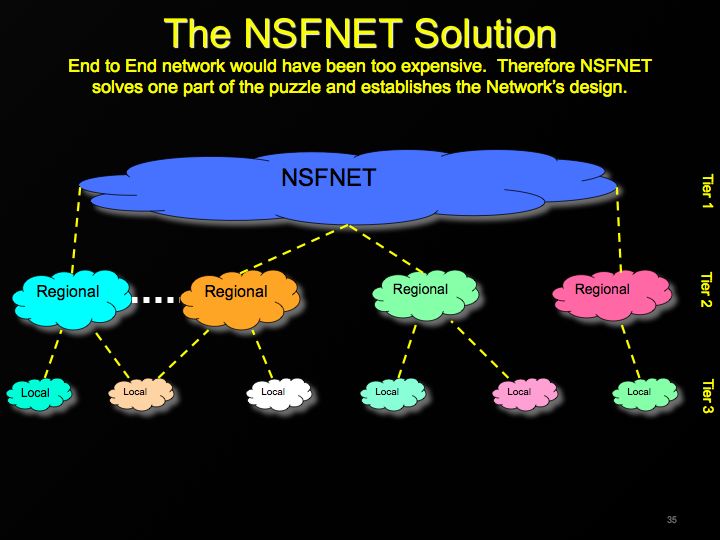
- it would be built in three tiers (campus, regional, backbone)
- NSF would fund the regional and backbone networks
Tiers: E Krol , E. Hoffman, RFC 1462, FYI on "What is the Internet" ? p 2 (May 1993) ("In response, NSF decided to build its own network, based on the ARPAnet's IP technology. It connected the centers with 56,000 bit per second (56k bps) telephone lines. (This is roughly the ability to transfer two full typewritten pages per second. That's slow by modern standards, but was reasonably fast in the mid 80's.) It was obvious, however, that if they tried to connect every university directly to a supercomputing center, they would go broke. You pay for these telephone lines by the mile. One line per campus with a supercomputing center at the hub, like spokes on a bike wheel, adds up to lots of miles of phone lines. Therefore, they decided to create regional networks. In each area of the country, schools would be connected to their nearest neighbor. Each chain was connected to a supercomputer center at one point and the centers were connected together. With this configuration, any computer could eventually communicate with any other by forwarding the conversation through its neighbors. ")
NSFNET and ARPANET interconnected at CMU. [Noam 63]
1986
| "The National Science Foundation's enlightened management of the NSFNET facilitated the Internet's first period of explosive public growth." - Living Internet, NSFNET |
NSF established the Computer and Information Science and Engineering directorate on October 1 which worked on the design of NSFNET. NSF knew that the cost of supporting a full end-user to end-user network would exceed NSF's resources. Therefore, NSF sought to achieve a more modest goal. By dividing the problem up into three parts, NSF sought to solve one part, and leave the other network parts to the respective counterparts. This established a three tiered design which in many ways still exists today: (1) the national backbone, (2) regional networks, and (3) campus networks. TCP/IP was adopted from the ARPANET design. [NSFNET Final Report p 11]
Following the CSNET model, the regional networks interconnected with NSFNET on a settlement free basis. [Mason p. 18 1993 (“Regionals, private backbones and users are not charged for connections to or usage of the NSFNET, which has been the primary backbone of the Internet. The full costs of NSFNET have been paid by NSF, IBM, MCI and the State of Michigan through 1994.”)]
Responsibility for the 56 kbps backbone was awarded to Univ. Illinois. Operations was with Cornell. [Braun ("When the links and nodes were deployed, the people responsible had problems making them work, so I made it work, and from then on ran (though unofficially but broadly known) the 56kbps NSFNET backbone via the USAN satellite link from the University of Michigan until 1988" )]
In 1986, Stephen Wolf becomes Division Director for Networking and Communications Research and Infrastructure at NSF where he oversees NSFNET. In 2013, Wolff was inducted into the Internet Hall of Fame.
NSF's vehicle of project management was a "cooperative agreement." Pursuant to the Federal Grant and Cooperative Agreement Act of 1977, a Cooperative Agreement (as opposed to a contract) is appropriate
"whenever -- (1) the principal purpose of the relationship is the transfer of money, property, services, or anything of value to the . . . recipient to accomplish a public purpose of support or stimulation authorized by Federal statute, rather than acquisition . . . of property or services for the direct benefit or use of the Federal Government; and (2) substantial involvement is anticipated between the executive agency, acting for the Federal Government, and the . . . recipient during performance of the contemplated activity."
[41 USC § 505
[S]ince the NSFNET was created as a resource for the U.S. research and education community, NSF was able to use a cooperative agreement as the award vehicle. Utilizing the cooperative agreement enabled the NSF to build and maintain a backbone network service in support of the research and education community while maintaining "a substantial involvement in the process," says Don Mitchell, Staff Associate at the NSF. A cooperative agreement was chosen as the award instrument for the NSFNET backbone because a contract is used only when procuring specific goods and services for the government, and a grant does not allow the government to significantly guide the management of a project.
[NSFNET Final Report p 12] Cooperative Agreements would also be used by NSF for the administration of the domain name system by Network Solutions, Inc.
The NSFNET project was overseen by NSF Division of Networking and Communications Research and Infrastructure.
NSFNET 1.0 got off to a relatively modest start in 1986 with 56 kbps connections, using LSI 11/73 gateway systems with 512 kbytes of memory, among the five NSF university-based supercomputer centers. [NSFNET Final Report p 15] [Salus p 199] [Kesan p 100] [Cerf 1995 ("The backbone itself was initially implemented using gateways (systems used to route traffic) developed at the University of Delaware and links operating at the ARPANET speed of 56K bps.")] Yet its connection with ARPANET immediately put NSFNET into the major leagues as far as networking was concerned. As with CSNET, NSF decided not to restrict NSFNET to supercomputer researchers but to open it to all academic users. The other wide-area networks (all government-owned) supported mere handfuls of specialized contractors and researchers.
Campuses spent approximately $100k per year per campus for connectivity to NSFNET [NSFNET FR p 17]
The flow of traffic on NSFNET was so great in the first year that an upgrade was required. [NSFNET FR p 15 (describing backbone as "saturated")] NSF issued a solicitation calling for an upgrade and, equally important, the participation of the private sector.
"NSFNET represented a major new challenge because it connected such a diverse variety of networks. The person who did more than anyone else to enable networks to talk to each other was NSF grantee David L. Mills of the University of Delaware. Mills developed the Fuzzball software for use on NSFNET, where its success led to ever broader use throughout the Internet. The Fuzzball is actually a package comprising a fast, compact operating system, support for the DARPA/NSF Internet architecture, and an array of application programs for network protocol development, testing, and evaluation. Why the funny name? Mills began his work using a primitive version of the software that was already known as the "fuzzball." Nobody knows who first called it that, or why. But everyone appreciates what it does." [Fuzzball: The Innovative Router, NSF] [Salus p 199] [Living Internet] [Braun]
October: NSFNET experiences Congestion Collapse which leads to the implementation of Van Jacobson's Congestion Control in 1988.
OFFICE OF TECHNOLOGY ASSESSMENT, U.S. CONGRESS, SUPERCOMPUTERS: GOVERNMENT PLANS & POLICIES (1986)
National Science Foundation Authorization Act for Fiscal Year 1987, Pub. L. No. 99-383, 100 Stat. 813 (1986)
Cerf 1995 ("Then-Senator Gore's 1986 legislation calling for the interconnection of the Centers using fiber optic technology ultimately led the administration to respond with the High Performance Computing and Communications (HPCC) Initiative.")
1987
NSF framed the 1987 upgrade solicitation in a way that would enable bidding companies to gain technical experience. The solicitation called for "a nationwide T1 backbone to address the chronic congestion on the 56 kbps NSFNET and ARPANET, and extend the new backbone's reach to include the emerging regional networks." [1987 Solicitation] [NSFNet Final Report p. 19] [NSF IG Sec III] [Kesan p 100] Leonard Kleinrock, et. al., Toward a National Research Network, National Research Council 12 (1988) ("These problems plague researchers seeking to use such networks as Arpanet even for such relatively undemanding applications as e-mail. They are even more troubling to researchers using the early NSFNET to access NSF-funded supercomputers. NSFNET limitations have not only frustrated researchers, as clearly reported to the committee, but also inhibit effective use of expensive supercomputing resources. (Plans to upgrade NSFNET, announced in the fall of 1987, may relieve some of these problems.)")]
"One of the firm requirements of the solicitation concerned the communications protocol standard: it had to be TCP/IP, created by Vint Cerf and Bob Kahn in 1973 as a research project on behalf of ARPA. Dennis Jennings at NSF chose TCP/IP, as opposed to other protocols, for the new NSFNET backbone because it was an open and non-proprietary standard, and also because the ARPANET used TCP/IP: "One of the things that helped jump-start the NSFNET was an agreement with ARPA to allow us to use the ARPANET for NSFNET traffic," recalls Jane Caviness." [NSFNET FR p 17] Hans-Werner Braun recalls
At that time considering IP was somewhat gutsy. The federal government had just issued a mandate not to use IP, but to embrace GOSIP (OSI protocol suite) instead. This made the days of the Internet, with their applications generally confined to a United States Department of Defense network-research context via the ARPAnet, seem to reach their close. Even the network protocol use by the supercomputing centers was inconsistent. SDSCnet embraced the Department of Energy MFEnet protocols, and USAN used Ethernet bridging. Both were problematic, as MFEnet was non-interoperable with other networking protocols, while bridged networks were hard to manage (we had "ARP wars in the sky"). And, for that matter, Merit for it's own network across multiple universities used home grown protocols. Without NSF's decision to embrace the Internet Protocol as the common denominator for an interoperable platform, it is unlikely the the Internet would have developed into the global cyberinfrastructure that it is today, and at least not that early on. My speculation is that instead phone companies would likely dominate the landscape, using X.25 or other OSI protocols for data communications. [Braun]
Six proposals were submitted to NSF; three were rejected as technologically unresponsive and three were competitive. [Merit History] [NSF IG Sec. III] The winning proposal was announced on November 24, 1987: it was a proposal led by Merit Network, Inc. (Eric Aupperle, Hans-Werner Braun), with the partnership of a consortium of Michigan universities, the state of Michigan, IBM and MCI. The grant length was 5 years. [Merit History] [Braun] [Medin Slide 7] [Kesan p 100, 107]
Merit's bid was for $14 m, substantially below the two other competing bids (the second bid was for $25 m and the third was for $40 m). The bid involved "an extraordinary degree of cost-sharing." It included $5 m from the state of Michigan for facilities and personnel, $6 m in reduced communication charges from MCI, and $10 m from IBM in equipment, installation, maintenance and operation. [NSF IG Sec. III].
The Merit team was responsible overall engineering, management, and operation of the project, as well as for developing user support and information services. [Project Solicitation 1992] [NSFNET Celebration (Van Houweling)] [Merit History] [NSFNet Final Report p. 7 (the Chair of the Board of MERIT at the time was Doug Van Houweling)].
IBM provided the hardware and software for the packet-switching network and network management. IBM had differing interests. The part of IBM involved with NSFNET was involved in academic computing (there were other parts of IBM that had networking interests that were not NSFNET). IBM had a big budget to do studies with universities. Studies made clear that open protocols were needed, and were advantageous because of IBM's development capabilities. IBM also knew that it had to do it if wanted to participate in future of data networks. IBM's commitment to open systems had its origins in IBM's participation in NSFNET. [NSFNET Celebration (Mazza)] [NSFNET Celebration (Bosco)]
MCI provided the transmission circuits for the NSFNET backbone, including reduced tariffs for that service.
"when we talked with MCI about wanting unchanneled T1 (1.5Mbps) links for the infrastructure (rather than multiplexing it down to 56kbps voice channels), they thought we are crazy. When we then told them that a few years later we would want unchanneled DS3 (45Mbps) they thought we are completely insane. But, to their credit, they worked with us through those issues" [Braun]
The NSFNet Final Report indicates that part of IBM and MCI's motivation was to take advantage of technology transfer, to become better acquainted with government funded R&D and explore ways to transfer this into private sector products and services. According to Al Weiss (at IBM at the time),
“IBM was unable to interconnect its large mainframes and some of its new workstations to all the research communities' networks and get adequate performance, because those networks were TCP/IP networks. By working on the NSFNET backbone service, we learned a lot about TCP/IP and were able to address these needs common in many academic
environments.”[NSFNet FR p. 8] [See Greenstein 76]
Michigan was experiencing high unemployment and was looking for public / private projects that might have return on investment. Michigan had the Michigan Strategic Fund that could invest in R&D type projects. Gov. Blanchard
NSF funds and establishes NANOG. William Norton, NANOG History v2.0
, 2007
OFFICE OF SCIENCE AND TECHNOLOGY POLICY, A RESEARCH AND DEVELOPMENT STRATEGY FOR HIGH PERFORMANCE COMPUTING (1987).
1988 - NSFNET 2.0:
|
View NSFNET July 1986 - 1988 in a larger map |
In July 1988, eight months after the award, the new T1 backbone was operational. [NSFNet FR p. 20] It connected thirteen regional networks and supercomputer centers, representing a total of over 170 constituent campus networks and transmitting 152 million packets of information per month. The backbone nodes (Nodal Switching Subsystems) were IBM RT system processors running Berkeley UNIX. The nodes provided packets switching, routing, and statistics gathering. [NSFNet FR p. 22] These nodes served to transfer traffic from the NSFNET backbone to the regional networks. The network linked to
- MERIT (then MichNet, first regional network to connect to NSFNET [NSFNet FR p. 25])
- the NSF supercomputer centers
- the National Center for Atmospheric Research
- Bay Area Regional Research Network (BARRNet) (San Francisco)
- MIDNET
- Westnet (moving bits closer to God - average altitude > 5000 feet)
- NorthWestNet
- SESQUINET
- Southeastern University Research Association Network (SURAnet) (connection point was at College Park, MD) [NSF IG Sec. II]
- NYSERnet
- JVNCnet
The NOC, the first of its type, was established at the University of Michigan. [NSFNet FR p. 23]
Yakov Rekhter co-designed the "Three Napkin Protocol" aka Border Gateway Protocol. This was the only interdomain routing protocol at the time. He sought to replace old Exterior Gateway Protocol EGP, which had problems such as IP fragmentation. Goal was to support a few thousand classful IPv4 routes. BGP was viewed as a short term solution. [NSFNET Celebration (Rekhter)] [Wikipedia BGP] [Braun]
The increased bandwidth supply offered by the upgraded NSFNET caused a surge in demand. Usage increased on the order of 20 percent per month [Merit History] [NSFNet FR p. 27 (setting monthly growth rate at 10%)].
July 24: NSFNET 1.0 56 kbps backbone is decommissioned. [NSFNet FR p 26] [Link Letter 1994]
Civilian NSFNet had to gain admittance to DOD IETF.
Another difficulty around that time was that control of the Internet evolution was pretty much with the United States Department of Defense, via groups such as their Internet Engineering Task Force. To address those concerns, Scott Brim and I met with people in the Pentagon to convince the DoD to at least open up the IETF to a larger community, specifically the NSFNET and its associated regional networks. To our surprise, one meeting was all it took, and they agreed, which lead to a rapid expansion of the IETF with a lot of involvement from many constituents over time. [Braun]
Morris Worm ripped through the network.
Vint Cerf persuaded NSF to allow MCI commercial email on the network on a experimental basis. [Kesan p 100] [Roberts] Compuserv and Sprint would soon also gain experimental access for commercial email. [Kesan p 100, 112]
NORDUnet
Computer Networks and High Performance Computing: Hearing Before the Subcomm. on Science, Tech., and Space of the Senate Comm. on Commerce, Science, and Transp., 100th Cong. 66-67 (1988)
1989
|
THE NSFNET BACKBONE SERVICES GENERAL PRINCIPLE: SPECIFICALLY ACCEPTABLE USES:
UNACCEPTABLE USES: |
NSFNET has 13 gateways at supercomputer sites or regional network centers:
- BARRNET - Bay Area Regional Research Network, (Palo Alto, CA)
- JVNCNET - John von Neumann Supercomputer Center Network (Princeton, NJ)
- MERIT - Merit Corporation (Ann Arbor, MI)
- MIDNET - Midwestern States Network (Lincoln, NE)
- NCSANET - National Center for Supercomputing Applications Network (Champaign, IL)
- NORTHWESTNET - Northwestern States Network (Seattle, WA)
- NYSERNET - New York State Education and Research Network (Ithaca, NY) (NYSERNET incorporated PSINET in 1989)
- PSCNET - Pittsburgh Supercomputing Center Network (Pittsburgh, PA)
- SDSCNET - San Diego Supercomputer Center Network (San Diego, CA)
- SESQUINET - Sesquicentennial Network (Houston, TX)
- SURANET - Southeastern Universities Research Association Network (College Park, MD)
- USAN - National Center for Atmospheric Research Satellite Network (Boulder, CO)
- WESTNET - Southwestern States Network (Salt Lake City, UT)
[NIST 1992 p 5]
Traffic projections indicated that the NSFNET would reach the limits of its T1 capacity during the next year. [NSF IG Sec. III.B.1] "When we first started producing those traffic charts, they all showed the same thing-up and up and up! You probably could see a hundred of these, and the chart was always the same," says Ellen Hoffman, a member of the Merit team. "Whether it is growth on the Web or growth of traffic on the Internet, you didn't think it would keep doing that forever, and it did. It just never stopped."
Merit began to plan for an upgrade of NSFNET from T1 (1.5 megabits per second or Mbps) to T3 (45 Mbps). [Cook] [OSTP, "The Federal High Performance Computing Program," (8 September 1989) (recommending migration of NREN to T3)] The T3 upgrade, like the original network implementation, deployed new technology under rigorous operating conditions. The upgrade, therefore, represented an organizational as well as a technical milestone-the beginning of the Internet industry. [NSFNET Celebration (Van Houweling) (describing the upgrade from T1 to T3 as the greatest technological challenge)] The breadth of the project before them lead to the proposal to outsource network management to a new entity, Advanced Networks and Services.
"Funding for four of the centers, San Diego, Urbana-Champaign, Cornell, and Pittsburgh, was renewed." [The Launch of NSFNet, NSF] NSF also funded several new nodes to the NSFNET. [NSFNet FR p. 28] Merit's funding increased from $14 m to $20 m based on the increase of traffic on the network and the additional nodes.
NSF drafts an Acceptable Use Policy for the NSFNET [NSF IG Sec. III.D]
U.S. CONGRESS, OFFICE OF TECHNOLOGY ASSESSMENT, HIGH PERFORMANCE COMPUTING AND NETWORKING FOR SCIENCE (1989)
OFFICE OF SCIENCE AND TECHNOLOGY POLICY, THE FEDERAL HIGH PERFORMANCE COMPUTING PROGRAM 10 (1989)
National High-Performance Computer Technology Act of 1989: Hearings on S. 1067 Before the Subcomm. on Science, Tech., and Space of the Senate Comm. on Commerce, Science, and Trans., 101st Cong. 66 (1989)
JUNET (Japan) interconnects with NSFNET.
1990
March: Meeting at Harvard re privatizing the NSFNET [Kesan p 100]
The Cooperative Agreement was amended on May 29, approving MERIT's plan to install new nodes as T3s instead of legacy T1s, and providing for additional funding. [NSF IG Sec. III.B.1] NSFNET consists of more than 1000 state, regional, and institutional networks, including well over 100,000 computers. [NIST 1992 p 5]
MERIT's proposal to migrate the entire network to T3 speeds was approved by NSF in November, with an increase of funding from $20 m to $28 m. [NSF IG Sec. III.B.1]
An Atlanta node was added to NSFNET, for a total for 14 nodes.
John Markoff articles on NSFNET begin to appear in the New York Times, raising the visibility of NSFNET. [Markoff]
- Vint Cerf, Thoughts on the National Research and Education Network, IETF RFC 1167 (Jul. 1990) ("The basic model of government backbones, consortium intermediate level nets and private local area networks has served reasonably well during the 1980's but it would appear that newer telecommunications technologies may suggest another potential paradigm. As the NSFNET moves towards higher speed backbone operation in the 45 Mb/s range, the importance of carrier participation in the enterprise has increased. The provision of backbone capacity at attractive rates by the inter-exchange carrier (in this case, MCI Communications Corporation) has been crucial to the feasibility of deploying such a high speed system.")
- Brian Kahin, Commercialization of the Internet: Summary Report, IETF RFC 1192 (Nov. 1990)
Advanced Networks and Services
On June 29, MERIT sent to NSF a letter describing its plans to establish a new not-for-profit entity called Advanced Networks and Services
This would be be a step toward privatizing the network. For the first time, a private organization principally owned the transmission lines and computers of the backbone. [FTC Staff Report 2007 p 18]
On September 10, NSF sent MERIT a letter stating "NSF agrees to MERIT's subcontracting services to the new corporation." [Cook pt 1] [Cook pt 2 (ANS received $9.3 million from NSF through MERIT for FY1991 (Oct 90 - Sept 91)] [NSF IG] [Kesan p 100] Pursuant to the email from NSF, new networks could connect to the ANS operated network under the following conditions:
NSF agrees that the new corporation may solicit and attach to the NSFNET Backbone new users, including commercial users, and may connect them to new or existing nodes on the Backbone, with the understandings that:
- such users will reimburse the new corporation for at least the full average cost of the connection, the added traffic, and additional related support, and
- the reimbursements will be used to enhance the network infrastructure and services, in order that the level of service provided by MERIT under its Cooperative Agreement with the NSF not be diminished.
[Cook pt 1 (citing Letter from Stephen S Wolff to Doug van Houweling (Sept 10, 1990))] [NSF IG Sec. III.C.1]
On September 17, MERIT, IBM, and MCI formed the non profit ANS after receipt of NSF's email. [NSF IG Sec. III.C.1.] [Kesan p 100]
| ANS Purpose from its Art. of Inc.: "The Corporation is a non-profit organization dedicated to the advancement of education and research in the interest of improving the ability of the United States to compete in the global economic environment. The Corporation will concentrate on computer networking and related services, an area clearly recognized as a vital component of United States competitiveness. The Corporation shall help establish a high-speed computer network which will be maintained at the leading edge of technology, and which will eventually feature multi-gigabit per second data transfer rates. The Corporation will also help to expand the access to and interchange of information technology resources among academic, government and industry users. In addition, the Corporation will engage in research and development work which will support the academic and research communities and contribute to United States preeminence in high speed network technology and related services." [NSF IG Sec. III.C.1] |
The creation of ANS led to a controversy that would lead to Congressional Hearings, an NSF Inspector General investigation, and the creation of the COM-PRIV email discussion group, discussed below.
1991
"NSFNET backbone was upgraded to 16 nodes operating at 45 Mbits/sec (T3)." [NIST 1992 p 6]
Jan. 1991 Hans-Werner Braun leaves MERIT for San Diego Supercomputer Center. [Braun]
In March 1991, the Internet was transferring 1.3 trillion bytes of information per month.
The new T3 service was fully inaugurated over Thanksgiving, representing a thirty fold increase in the bandwidth on the backbone. [Merit History] The network linked sixteen sites and over 3,500 networks. The T3 nodes utilized IBM RS/6000 workstations running UNIX, which did the same work as nine IBM RTs that had made up the previous NSS's, but at a faster speed. [NSFNet Final Report p. 28].
Advanced Networks and Services
May 24, "NSF agrees that ANS may move commercial traffic in both directions across the NSF sponsored Backbone gateways." [Cook pt 3 (quote email from Steven Wolff, NSF to Eric Aupperle, MERIT (May 24, 1991)] This led to the May 30th incorporation of a for-profit ANS CO-RE, Inc. [NSF IG Sec. III.C.1] [Srinagesh 143] On August 14, ANS announced its Plan for Commercial Services. [Cook pt 3] Cook argues that ANS's planned customer base were those regional networks that were receiving network service from the non-profit NSNFNET.
In the May 24 email, NSF set forth the following conditions for permitting commercial traffic over the MERT/ANS backbone:
"NSF agrees that ANS may move commercial traffic in both directions across the NSF sponsored Backbone gateways, providing that:
"(1) ANS recovers at least the average cost of the commercial use that traverses the NSF sponsored gateways.
"(2) Excess revenues recovered above costs for this use after tax will be placed in a pool to be distributed.
"(3) An ANS resource allocation committee will be formed with representation from the participating NSF sponsored gateway management, other network organizations, the NSF and ANS to distribute those funds with the objective of further building national and regional infrastructure, and
"(4) MERIT and ANS ensures that the attachment and service sponsored by the NSF under Merit's Cooperative Agreement with the NSF is not diminished.
"NSF, MERIT and ANS will agree on the technical means of compliance with the points outlined above."
[NSF IG Sec. III.C.1] [Srinagesh 142 (ANS's interconnection offer would have distinguished commercial and academic traffic; sampled to determine the percentage of academic traffic; charged for services based on the percentage of traffic that is commercial.)] [Noam 64]
Of course segregating commercial traffic over the backbone from academic and research traffic would be a bit of a challenge. Any network that did want to exchange commercial traffic over the NSFNET would have to execute a contract with ANS and become a customer for ANS, distinct from NSFNET.
Acceptable Use Policy
Demand for Internet access in the non-academic / research world grew; NSFNET's Acceptable Use Policy however forbade commercial traffic over the NSFNET. This demand for service led to many privately owned networks starting to appear and offer service. Since the private networks were precluded from exchanging commercial data traffic over NSFNET, the backbone operators established the Commercial Internet Exchange ("CIX") to interconnect their own backbones and exchange traffic directly. CIX Router went online in 1991. [Hussain Historic Role CIX 2 ("At that time ANS was seen as having a de facto monopoly because it both operated the NSFNET under an AUP while at the same time using the same network infrastructure to operate a commercial Internet service for profit. ANS faced mounting criticism that it was using government funds to operate a commercial service and using its position as the operator of the NSFNET to restrict the emergence of new Internet Service Providers that could compete directly against it.")]
"Transmitting porn across the Internet was in violation of NSF and Federal Appropriate Use Policies, but was quite popular when it uploaded, usually in a hidden location. We had to police it because we did not want to be written up about federal dollars being used to transport porn (and possibly have federal funds cut off because of it). Our international links were quite modest, and anytime they redlined, porn was often to blame." [Medin Slide 10] (See also Communications Decency Act)
The Organization of America States
High-Performance Computing and Communications Act of 1991: Hearing Before the Subcomm. on Science, Tech., and Space of the Senate Comm. on Commerce, Science, and Trans., 102d Cong. 90 (1991).
1992
"Numerous other government networks have gateway connections (existing or planned) to NSFNET - including the NASA Science Internet (NSINET), the Energy Science Network (ESNET) and others. In general, the Federal agencies have a vested interest in the Internet." [NIST 1992 p 6]
NSF Management and the ANS Controversy:
The NSFNET Final Report describes the controversy that occurred as follows:
According to George Strawn, there were two main issues of concern with regard to the so-called "commercialization and privatization of the Internet." One was what effects the NSF's ongoing support of the NSFNET would have on the fledgling Internet service provision market; new companies such as Performance Systems International (PSI) and AlterNet charged that the NSF was unfairly competing with them. The second issue was the research and education community's concern that "commercialization"-part of which was the perception that ANS would provide the NSFNET backbone service instead of Merit-would affect the price and quality of their connection to the NSFNET and, by extension, the Internet. They wanted to "keep it in the family," says Strawn.
On yet another front, the regional and midlevel networks were beginning to attract commercial customers, and wanted that business for much the same reasons that ANS was created: to support themselves and the research and education community. However, they felt constrained by the NSF's Acceptable Use Policy, which specified the nature of traffic allowed to traverse the NSFNET backbone service. Purely commercial traffic was not directly in support of research and education and was thus restricted from the NSFNET backbone. "Something had to happen to break loose the whole commercial issue," says Ellen Hoffman.
[NSFNET FR p 31] The controversy crescendoed into a Congressional hearing in March:
Management of NSFNET. Hearing before the Subcommittee on Science of the Committee on Science, Space, and Technology, U.S. House of Representatives, One Hundred Second Congress, Second Session. March 12, 1992 . Held by Rep. Rick Boucher
- Abstract: " The Science Subcommittee began its oversight of the implementation of the High-Performance Computing Act of 1991 by focusing on the establishment of the National Research and Education Network (NREN), which will evolve out of the current internet, the National Science Foundation's (NSF) NSFNET. The policy issues under discussion were: providing a level playing field for network services providers; ensuring that the network is responsive to user needs; providing for effective network management; determining the level of consultation that has occurred between the NSF, the network user, and provider communities during the course of developing the policies for governance and operation of the NSFNET backbone; and moving toward the long-term vision for the NREN, including the appropriate roles of the public and private sectors. Included in the hearing report are statements from Bob Traxler and Jerry F. Costello of the House Subcommittee on Science and testimony from the following witnesses: Eric Hood, Federation of American Research Networks and Northwestnet, Inc.; Douglas E. Van Houweling, Merit Network, Inc. and the University of Michigan, Ann Arbor; Mitchell Kapor, Commercial Internet Exchange Association and Electronic Frontier Foundation; Michael M. Roberts, Educom; William L. Schrader, Performance Systems International, Inc. Also included are a statement by A. Nico Habermann and Stephen S. Wolff, National Science Foundation; the Subcommittee and Full Committee markups of H.R. 5344, Amendment to the NSF Act of 1950; and an additional statement submitted for the record by E. Michael Staman, CICNet. (ALF)"
- See also [Cook pt 4] [Kesan p 100]
This hearing led to a request from Rep. Boucher to the NSF Inspector General to conduct an investigation of NSFNET. [NSF IG Sec I] A summary of the IG's report, released in 1993, is provided below.
Peter Salus summarized the controversy as follows:
The handing over of the infrastructure of NSFNET to a commercial entity made some of the other commercial network suppliers a bit queasy: After all, the NSFNET, built with taxpayer's funds, would not be in competition (as ANS) with private entities, and ANS had agreed with MERIT (in November 1992) to "monitor commercial traffic" on the backbone to ensure that commercial users weren't eating into the bandwidth promised to NSF research and education clients.
[Salus p 200] Wikipedia has this rendition of the controversy:
The NSF chose a vendor and a model on its own initiative to do commercialization using the same infrastructure as the NSFNet called ANS (Advanced Network Services) led by IBM Yorktown Heights. While the conflict (with the efforts of UUNET, PSINet, CIX and other private networks) was apparent to some it was not to the NSF. More importantly the NSF and ANS had a settlement model which they believed would provide for an Internet for themselves and commercial entities, this settlement model was based on how many bytes of data were sent to you. This model had great advantages to those who provided servers in the center of the Internet which of course was the situation that the NSFNet and ANS happened to be in. This "great debate" was had in very select forums amongst very select parties until the establishment of the "com-priv" public mailing list at PSInet (specifically com-priv@psi.com).
ANS business model was to sell to the regional networks and other backbone networks (1) long haul transport and (2) access to ANS customers (in other words, ANS was selling transit). Gordon Cook recounts, since "ANS needed hefty settlements revenues from traffic that crossed its network in order to achieve its goals." [Cook pt 3]
Commercial Internet eXchange and ANS
Commercial Internet backbone networks arose that did not need ANS's transport / transit service. However, ANS had customers that the commercial network's customers wanted to reach. ANS attempted to leverage its larger size and access to its customers to impose settlement frees on the other networks. The commercial networks argued that interconnection with ANS and the exchange of traffic between the two services (without the use of long haul transport by either) constituted a mutual exchange of benefit (peering). Therefore they argued that this should be done on a settlement free basis. ANS refused. Therefore the existing commercial networks formed the Commercial Internet eXchange. [Srinagesh 142] [Noam 64]
"ANS refused to join the CIX." [Cook pt 3]
With the CIX gaining more and more commercial ISPs quarter by quarter and then month by month, and with the NSFNet/ ANSNet building traffic based on its University usage, a "compromise" was needed. At that point Mitch Kapor took over the chairmanship from Marty Schoffstall and forged an agreement with ANS to connect to the CIX as a "trial" by which they could leave with a moment's notice. [Wikipedia]
The agreement was announced in May. While ANS connected with CIX in June, it did not become a member of CIX. [Cook pt 3] [Kesan p 100] [Noam 64] [Srinagesh 143]
The NSFNET Final Report reflected on the controversy as follows:
In retrospect, such growing pains were unavoidable, considering the scope of the technological achievement and importance of networking and communications infrastructure to academic (and commercial) users. Thus the upgrade of the NSFNET backbone service to T3 was not only a technological and organizational challenge of the highest order. It also precipitated a greatly needed, though contentious, community dialogue about the evolution of the communications infrastructure that had come to mean so much to the research and education community and, increasingly, the society as a whole.
[NSFNET FR p 32]
The situation with ANS might be contrasted with the relationship NSF had with Network Solutions (NSI) for DNS services. NSF used its cooperative agreements with NSI in order to contract out the function of administering the domain name system. Like the arrangement with ANS, NSF was using government funds to set up one private company to offer Internet services, without having complete contractual control over how those services were administered. Unlike a government contract, the assets created pursuant to a cooperative agreement were the property of the private company with no further government recourse. This put NSF in the position of funding one company's R&D and hand picking the first mover in a market. The situation with ANS was surpassed by CIX and private commercial networks; the situation with NSI and DNS however took a great deal more consternation ultimately leading to the Department of Commerce taking over responsibility and the formation of ICANN.
Leonard Kleinrock, et. al., Realizing the Information Future: The Internet and Beyond, National Research Council 176 (1994) ("The withdrawal of NSFNET backbone support was motivated by arguments that such federal funding constituted a market-distorting subsidy, inhibiting the entry of competitive providers.")
Nov. 22: On the expiration of the NSF Cooperative Agreement with MERIT, NSF extends the agreement "12 to 18 months while the backbone was put through a re solicitation process." [Cook pt 3] [NSF IG Sec. IV.C.3] [NSF IG Sec. III]
Scientific and Advanced Technology Act of 1992, introduced by Member of Congress Rick Boucher
"The Foundation is authorized to foster and support the development and use of computer networks which may be used substantially for purposes in addition to research and education in the sciences and engineering, if the additional users will tend to increase the overall capabilities of networks to support such research and education activities."
[42 U.S.C. 1862(g)] [ H.R. Rep. No. 567, 102d Cong., 2d Sess. 4 (1992)] [Nerds2.0 p 297] [NSF IG Sec. IV.D.] [Greenstein 2015 p. 85 ("That slight change in words made all the difference. It meant that the NSF did not violate its charter when it shared lines with private users because sharing those lines lowered the costs to researchers in the sciences and engineering fields.")]
In preparation for switching from NSFNET to private backbones, and implementing NSF's plan to build Network Access Points for backbone interconnection, on June 15 NSF released for comment a proposed solicitation "Network Access Point (NAP) Manager and Routing Authority (RA) organization; and a provider of very high speed Backbone Network Services (vBNS)" [NSF IG Sec. V.A.]
By 1992, over 6,000 networks were connected, one-third of them outside the United States.
Dec. 2 : Network migrated to DS3 [Medin Slide 11] [Kesan p 100] [Odlyzko1998 p. 10]
1993
NSF released National Science Foundation Solicitation 93- 52, Solicitation for Network Access Point Manager, Routing Arbiter, Regional Network Providers, and Very High Speed Backbone Network Services Provider for NSFNET and NREN Program
- that commercial Internet Service Providers would replace NSFNET, and would interconnect at Network Access Points (NAPs).
- "A Routing Arbiter (RA) would then manage a routing database and provide routing information to the NAPs to ensure orderly exchange of traffic."
- Very High Speed Backbone Service vBNS would replace NSFNET for high speed research and academic connectivity.
[Merit History] [FTC Staff Report 2007 p 18] [Kesan p 115]
NSF Inspector General released its report of its investigation of NSFNET. Office of Inspector General NSF, Review of NSFNET
- "NSF's decision to award the Cooperative Agreement for NSFNET to Merit was reasonable."
- NSF's proposal to upgrade NSFNET to T3 was reasonable.
- The NSFNET solicitation envisioned expansion and improvement of the network and therefore it was reasonable to amend the Cooperative Agreement as oppose to initiating an new solicitation.
- "NSF reasonably concluded that allowing commercial use of the network -- with the conditions NSF imposed -- is consistent with NSF's overall statutory mandate "to foster the interchange of scientific and engineering information among scientists and engineers" and "to foster and support the development and use of computer and other scientific and engineering methods and technologies, primarily for research and education in the sciences and engineering""
- "In view of the fact that the objectives of the program were furthered by commercial use of the network, the mere fact that an unexpected benefit accrued to the awardee is not objectionable and would not require a re-solicitation."
- "At least for the term of the NSFNET Cooperative Agreement, CO+RE's after-tax profits will fund the infrastructure pool, to be distributed according to the principles discussed above; even after the term of the Cooperative Agreement, if the profits are received by ANS in the form of dividends, they must be used in a manner consistent with ANS's tax-exempt status."
- "NSF has publicly stated that if another company wishes to send commercial traffic over the T3 network set up by NSF and Merit/ANS, it can do so on the same terms accorded to CO+RE."
- "The NSFNET program is a paradigm for the use of a cooperative agreement "
NSF grants MERIT funding to acquire commodity backbone services to replace its connection to NSFNET. [Merit History]
R. Aiken, H. Braun, and P. Ford, "NSF implementation plan for interim NREN", in Journal on High Speed Networking, vol. 2, pp. 1--25. IOS Press, Amsterdam, NL, Jan 1993 ("This document outlines an architecture and implementation plan for the National Science Foundation's Interagency Interim National Research and Education Network (NREN) component of the HPCC Program.")
Public Access to the Internet Conference, JFK School of Government, May 26-27, 1993 (discussing privatization of the Internet)
 Source: Searching for Data Information at a Directory Level, NSSDC News Volume 10, Numbers 3 & 4, December 1994 |
1994
NSF awards grants for the construction of four Network Access Points:
- New York (Sprint
- Wash DC (MFS) (aka MAE EAST now operated by Verizon,),
- Chicago (Ameritech) (aka MAE Central), (acquired by AT&T)
- San Jose (Pac Bell) (aka MAE West) was FIX-West). [Living Internet: NSFNET] (acquired by AT&T)
MERIT wins award to act as routing arbiter and does this work in partnership with the Information Science Institute
May: NSF renews Cooperative Agreement with MERIT through April 1995. [NSFNET FR p 41]
Networks begin to migrate off of NSFNET
"By the end of 1994, NSFNET was transmitting 17.8 trillion bytes per month, the equivalent of electronically moving the entire contents of the Library of Congress every four months."
"Through the end of 1994 NSFNet was carrying almost all of the non-military backbone traffic... They show that at the end of 1994, the 19 T3s in the NSFNet backbone were operating at about 5% average utilization." [Odlyzko1998 p. 10]
ANS
ANSNet: 45 Mbps network interconnecting with NSFNET, FIX-East, FIX-West, REDMEX, XLINK, fONOROLA and CIX. [Frey p 34]
CIX grew rapidly. Regional and campus networks that connected to NSFNET and whose business the for-profit ANS had sought, had an alternative. CIX, through settlement free peering, was able to grow its interconnected networked community faster, benefited from network effect, and soon surpassed ANS. Soon ANS would need CIX more than CIX needed ANS. In 1994, CIX blocked ANS traffic. The value of the interconnection was greater to ANS than it was to CIX - therefore ANS finally joined CIX and paid the memberhsip fee. O'Brien, Robert; Kazanjian, Dolores, ANS Joins CIX Alliance, Telecommunications - Americas Edition;Feb94, Vol. 28 Issue 2, p10 [Greenstein 2015 p. 81 ("Just a little less than a year later, CIX essentially had everyone except ANS. By the time Boucher held his hearing, ANS had become isolated, substantially eroding their negotiating leverage with others. By June 1992 ANS's settlement proposals no longer appeared viable. In a very public surrender of its strategy, it agreed to interconnect with the CIX on a seemingly short-term basis and retained the right to leave on a moment's notice.)] [Noam 63 (""Soon the relative use by the commercial and nonprofit sectors kept shifting, and the power over interconnection moved to the former. By 1993, approximately 80 percent of all Internet sites could be accessed outside the NSFNET structure. CIX blocked ANS traffic from routing through the CIX router, thus depriving ANS users of connectivity to CIX members. Humbled, ANS joined CIX in 1994"")] [Srinagesh 143 "In October 1993, CIX, apparently without warning, blocked ANS traffic from transiting the CIX router. At this point, ANS (through its subsidiary CO-RE) joined the CIX and full connectivity was restored."]
NSFNET deploys Classless Internet Domain Routing protocol (CIDR) in order to conserve IP addresses. [Link Letter]
1995
| Application | % of traffic |
| WWW | 21 |
| FTP-Data | 14 |
| NNTP | 8 |
| Telnet | 8 |
| SMTP | 6 |
| IP | 6 |
| Domain | 5 |
| IRC | 2 |
| Gopher | 2 |
| FTP | 1 |
| Other | 27 |
[NSFNET FR p 35] |
|
April 30: NSF decommissioned NSFNET. The public Internet is born.
"By 1995, it was clear the Internet was growing dramatically. NSFNET had spurred Internet growth in all kinds of organizations. NSF had spent approximately $30 million on NSFNET, complemented by in-kind and other investments by IBM and MCI. As a result, 1995 saw about 100,000 networks-both public and private-in operation around the country. . . . The efforts to privatize the backbone functions had been successful, announced Paul Young, then head of NSF's CISE Directorate, and the existing backbone was no longer necessary." [The End of a Beginning, NSF] [FTC Staff Report 2007 p 18] [NSFNET FR p 41]
Advanced Networks and Services
Traffic on NSFNET April 1995 (WWW traffic exceeds FTP traffic for first time) (see chart to the right)
1996
NSF Announces it will no longer fund NAPs. [Kesan p 117]

Very High Speed Backbone Network System
(Derived From from NSF Nifty50
The very high speed Backbone Network System (vBNS) and the Next Generation Internet (NGI) are funded in part by NSF. NSF and MCI are entirely responsible for vBNS. The vBNS is a nationwide network that operates at a speed of 622 megabits per second using
MCI's network of advanced switching and fiber-optic transmission technologies. At speeds of 622 megabits per second, 322 copies of a 300-page book can be sent every seven seconds.
Speed for research
Launched in April 1995 the vBNS is the product of a five-year cooperative agreement between MCI and NSF to provide a high-bandwidth network for research applications. The vBNS is only available for meritorious research projects with high-bandwidth uses and is not used for general Internet traffic. The vBNS provides to NSF-designated organizations a high-performance production research platform with service features and performance characteristics designed to be one step ahead of what is currently available with the commercial Internet.
vBNS and the Internet
What's the difference between the vBNS and the Internet? The Internet is a ubiquitous network that has become an information tool for researchers, students, teachers, business and the general public. The vBNS is a noncommercial research platform for the advancement and development of high-speed scientific and engineering applications, data routing and data-switching capabilities.
CyberInfrastructure: Networking for Tomorrow NSF
As NSF worked to privatize the mainstream Internet in the mid-1990s, the foundation also signed an agreement with MCI in April 1995 to establish the very-high-performance Backbone Network Service (vBNS) . Without competition from general Internet traffic, the vBNS permitted advanced networking research and the development of novel scientific applications. The vBNS initially connected the NSF supercomputer centers and NSF-specified Network Access Points, where linked the vBNS to other research networks.
The vBNS began operating at speeds of 155 megabits per second (Mbps), or OC-3, at a time when the fastest general Internet links operated at 45 Mbps. In 1997, the vBNS backbone was upgraded to 622 Mbps (OC-12). The vBNS also supported new technologies, such as IPv6, to meet the special needs of advanced applications. By 2000, the vBNS backbone was upgraded to 2.4 gigabits per second (OC-48). In 2000, NSF awarded MCI a three-year, no-cost extension to continue operating the vBNS for university customers; commercial connections to vBNS were also offered for the first time.
With the start of the vBNS, NSF began a series of programs designed to help universities and research institutions join advanced high-performance research networks. In its eight-year history, the High-Performance Network Connections program helped 250 institutions enhance their high-end network connectivity.
In 1998, WCOM acquired MCI: the MCI backbone went to Cable & Wireless however vBNS went to WCOM (later acquired by Verizon). [Verizon Press Release , Verizon Business to Deploy Next-Generation Internet Protocol Across Company's Global Public IP Network Sept 25] When the original contract with MCI and NSF for vBNS expired, much of the academic traffic migrated to Internet2 and Internet2 establishes Abilene. [Kesan p 115]
Legacy of NSFNET
According the Jessica Yu, as quoted in the NSFNET Final Report,
"The NSFNET backbone glued together the international networks-almost all traffic from abroad would transit the NSFNET. With that kind of connectivity available, other countries were prompted to build their own networks so they could get connected too. Many of them used NSFNET's three-tiered structure-backbone, regionals, campus networks-when they started to build their own networks."
[NSFNET FR p 34] This was true domestically as well as internationally. ARPANet had successfully established what could be done with packet switched networks. With ARPANets proof of concept came a cacophony of national, regional, and local data networks. NSFNET was the historical glue that transformed Babylon into a network of a single voice - the Internet speaking TCP/IP.
"At its peak, the NSFNET connected more than 4,000 institutions and 50,000 networks across the Unites States, Canada, and Europe." [Living Internet, NSFNET] [NSFNET FR p 33]
NSFNET was the incubator for the commercial networks that would launch in the early 1990s and become the initial Tier 1 backbone networks.
With NSFNET, NSF was in the process of giving birth to the Public Internet. The problem was, NSF did not want to be the "public" in Public Internet. This void led to public policy anxiety; how do we resolve the "public" in Public Internet. This anxiety leads to the creation of ICANN and the Network Neutrality debates.
Last Words:
"Since the earliest days of the telegraph and the telephone, history tells us that the arrival of each new communications medium has been accompanied by grandiose claims of its potential benefits to society. In order to take advantage of the exciting opportunities afforded by today's technology, it is imperative that policy makers examine the development of the NSFNET and the Internet. We are still far away from a truly open, interoperable, and ubiquitous global information infrastructure accessible to all, "from everyone in every place to everyone in every other place, a system as universal and as extensive as the highway system of the country which extends from every man's door to every other man's door," in the words of Theodore Vail, president of AT&T in 1907. However, the Internet has brought us a giant step closer to realizing the promise of high-speed networking, one of the most revolutionary communications technologies ever created. As part of this phenomenon, the NSFNET backbone service provided a model for future partnerships as well as a legacy of technology for the world."
[NSFNET FR: Conclusion p 43]
Funding
NSF funded NSFNet for $200 m from 1986 to 1995 [ISOC] [Kesan n 28] Other public sources are estimated to have spent $2 billions related to NSFNET. [Kesan n 28]
Leonard Kleinrock, et. al., Realizing the Information Future: The Internet and Beyond, National Research Council 175 (1994) ("Total federal funding for the NREN program was $114.4 million in FY93 and is expected to be $142.1 million in FY94, with significant amounts from this funding expected to cover the extra costs associated with making the transition from the larger NSFNET to commercial service and a separate research network (the vBNS). The budget request for FY95 is $176.8 million. These figures cover all aspects of the NREN program, including research, application development, and network operation among the National Science Foundation (NSF), the Advanced Research Projects Agency (ARPA), the U.S. Department of Energy, and the National Aeronautics and Space Administration, which account for the largest segments of the NREN budget, and other High-Performance Computing and Communications (HPCC) agencies (the National Institutes of Health, National Security Agency, National Oceanic and Atmospheric Administration, Environmental Protection Agency, National Institute of Standards and Technology, and Department of Education). The ARPA and NSF receive the largest shares of the NREN program budget; the ARPA portion of this program was $43.6 million in FY93 and $48.7 million in FY94, and the NSF portion was $40.5 million in FY93 and $47.9 million in FY94.")
Leonard Kleinrock, et. al., Realizing the Information Future: The Internet and Beyond, National Research Council 176 (1994) (" long-haul circuits operate at 45 Mbps, which costs, at tariff rates, about $45 per mile per month. Very approximately the total number of T3 circuit miles in the NSFNET backbone is about 16,000 miles and so might cost about $720,000 per month.")
"Leased lines and routers amounted to 80% of total NSFNET costs. The cost of the NOC amounted to another 7%." [Mason p. 5 1993] [Srinagesh 129] “The current annual total cost per T1 connection is about $25,000 to $35,000.” [Mason p. 18 1993]
"The NSF in 1993 spent about $11.5 million to operate the NSFNET and provided $7 million per year in grants to help operate the regional networks. NSF grants also help colleges and universities connect to the NSFNET. Using the conservative estimate of 2 million hosts and 20 million users, this implies that the 1993 NSF Internet subsidy was less than $10 per year per host, or less than $1 per user. " [Mason p. 5 1993]
Conclusion: E Krol , E. Hoffman, RFC 1462, FYI on "What is the Internet" ? p 2 (May 1993) (" For our purposes, the most important aspect of the NSF's networking effort is that it allowed everyone to access the network. Up to that point, Internet access had been available only to researchers in computer science, government employees, and government contractors. The NSF promoted universal educational access by funding campus connections only if the campus had a plan to spread the access around. So everyone attending a four year college could become an Internet user. ")
References
- The Internet - The Launch of the NSFNet, NSF
- 1987 NSFNET Implementation Plan
- Project Solicitation for Management and Operation of the NSFNET Backbone Network (NSF 87-37) (released June 15, 1987) (submissions were due August 14, 1987)
- FY 1997 Implementation Report, NSFNET, NSF
- Draft Minutes Federal Networking Council Advisory Committee Meeting, October 10-11, 1995
- "Proposal for the Management and Operation of the NSFNET Backbone Network: Expansion," submitted by Merit (February 1989)
- "Revised Statement of Work / NSF Supplemental Proposal No. 8944037" (20 April 1990)
- "Scope of Work Revision / Proposal No. NCR-8912875" (30 April 1990)
- "Public Draft -- Network Access Point Manager / Routing Authority and Very High Speed Backbone Network Services Provider for NSFNET and the NREN Program," 57 Fed. Reg. 26,692 (1992)
- NSF9224--Network Information Services Manager(s) for NSFNET and NREN, Project Solicitation (March 19, 1992) ("Information service for NSFNET mid-level network providers have been provided by MERIT Inc under Cooperative Agreement NCR-8720904 as part of the management of the NSFNET backbone")
- Office of Inspector General NSF, Review of NSFNET (Mar 23, 1993)
- Solicitation 93- 52, Network Access Point Manager, Routing Arbiter, Regional Network Providers, and Very High Speed Backbone Network Services Provider for NSFNET and the NREN Program. 1993
- E Krol , E. Hoffman, RFC 1462, FYI on "What is the Internet" ? p 2 (May 1993) (" At first, the NSF tried to use the ARPAnet for communications, but this strategy failed because of bureaucracy and staffing problems. ")
|
www.flickr.com
This is a Flickr badge showing public items from Flickr tagged with NSFNET Celebration. Make your own badge here.
|
© Cybertelecom ::News
- Andrew Lawler, NSF Hands Over the Internet . . ., 267 SCIENCE 1584 (1995)
- A Giant Step Towards Internet Commercialization? The Evolution of Internet into the National Research and Education Network, TELECOMMUNICATIONS, June 1991
- MCI and IBM Form Nonprofit Supercomputing Company, COMM. DAILY, Sept. 18, 1990